Pennsylvanian Inventor Touting Cancer "Cure"
Cancer is a challenge. It is a challenge to patients. It is a challenge to their families. It is a challenge to researchers.
A leukemia patient from Erie, Pennsylvania decided to take matters into his own hands. His name is John Kanzius and he doesn't have an MD, Phd, or even a bachelors degree. He is, however, a creative mind who has been a radio and TV engineer for most of his life. Kanzius put his experience with radio wave technology to use when he coupled it with cutting edge nanotechnology. He and his partners have created injectable nanoparticles which generate heat when they are exposed to low frequency radio waves. This is definately and interesting and inspirational story.
Kanzius's energy transfer technology sounds fascinating, it really does. The idea of being able to heat small particles with projected radio waves could have lots of uses. Unfortunately, I just don't think its a cure or even a particularly useful technology for the treatment for cancer. Sorry, Mr. Kanzius.
Basically, Kanzius wants to physically perturb the cancerous cells by cooking them. He says that cancer cells will die when exposed to temperatures over 130 degrees. Well, so will healthy cells. While that is an interesting idea, it really isn't very much different from killing the cancerous cells chemically with chemotherapeutics or with targeted radiation. One would still need to contend with the issue of cell/tissue specificity.
The biggest challenge, which Kanzius addresses/glosses over in interviews, will be the targeting of cancer cells only. How will he keep his nanoparticles from cooking the rest of patients' cells? How is this any different from chemotherapy which targets cancer cells in a rudimentary way by targeting dividing cells? Honestly, one could make a case to say that chemotherapies are ahead of Kanzius' radio nanoparticles because at least there is some specificity. I suppose the advantage of his technology is the fact that "treatment" can be turned off when the radio wave generator is turned off.
For his technology to work, aptamers will need to be developed. Aptamers are oligonucleotides or peptides which stick to cell specific molecules. In research, they are often bound to pharmacological agents or cell markers.
The aptamers, whether for Kanzius' superheated nanoparticle antennas or cytotoxic chemicals, would likely need to be different for each tumor type. The means that the problem remains a discovery biology dilemma. Discovery biologists and the pharmaceutical companies for whom Kanzius seems to express considerable disdain have been working on this same problem for years. They've just been trying to selectively target their chemotherapy drugs instead of superheatable nanoparticles. Discovery efforts to generate cell specific aptamers are almost as involved and expensive as any drug discovery effort. Also, the idea of verifying that an aptamer only binds to a tumor cell is a huge undertaking. Researchers would basically need to undertake an enormous protein specificity assay. Today, proteomics efforts are still cumbersome and expensive. If researchers try to take short cuts and bypass any of these experiments, we might have doctors saying, "Oops, I fried your kidney...Sorry, didn't think it was going to do that...". More concerns involve heavy metal poisoning, nanoparticle immunoreactivity, and the pharmacodynamics of the aptamer, just to name a few.
So while Kanzius should be commended for his ingenuity in introducing a new technology to the cancer fight, Joyce Savocchio (the former mayor of Erie) probably should not be declaring him a future Nobel Laureate or calling Erie the place where cancer was cured. Perhaps he should also temper his own rhetoric a little bit, particularly when he implies that no one else is working very hard on the cancer problem. He and Ms. Savocchio sound ignorant to the real issues.
Showing posts with label cancer. Show all posts
Showing posts with label cancer. Show all posts
Tuesday, August 28, 2007


Sunday, July 8, 2007
Cancer: A Mistep into Chaos Quicksand?
I spent much of this weekend pouring over two publications. The first, Probing Genetic Overlap Among Complex Human Phenotypes, was published in PNAS. Gene Expression has a nice post about the publication. While the paper itself focuses on genetic overlap between Autism, Schizophrenia, and Bi-polar Disorder, the scope of the work spans across over 150 diseases which were all compared in a pair-wise fashion. My personal interests in this work lie in their findings regarding Amytrophic Lateral Sclerosis which the authors included in their 200+ pages of supplementary materials. As I learn more about this work, I will share more about my understanding of the potential significance.

----------------------------
The second publication I spent a lot of time attempting to wrap my feeble mind around this past weekend was a fascinating conceptual "modeling" paper written by Dr. Ivo Janecka, MD, MBA, PhD (that's a lot of letters...). As I mentioned in my post about Miuro, I am very much intrigued by chaos mathematics and non-linear dynamics. It is the most ambitious of my many amateur interests.
The introduction of Janecka's publication starts with a quote by Fritjof Capra saying:
When I decided to pursue a career in life sciences, it was because I could not imagine that any other field of study could offer systems as beautiful and mysterious as life. I also could not imagine a field that could offer so much promise to help fellow humans once some of the mysteries were unlocked.
In this publication, Janecka offers a conceptual model for life systems. He describes life as a "non-linear dynamical system following the principles of organized complexity" with a "health territory" defined by the the systems ability to self-organize and self-adapt.
OK, so what does that mean? Let's take it one part at a time.
What is a non-linear dynamical system?
This is a system where small changes to early conditions can directly result in hugely different results at some later time. Many people have heard of the concept of a butterfly fluttering its wings on the North American west coast resulting in dramatic changes to huge tropical weather system on the east coast. Weather patterns are good examples of non-linear dynamical systems.
What is self-organization?
A system that self-organizes is one that will find a way to go back to "normal" after it has been disrupted. Imagine a beehive that is completely buzzing with activity. Now, imagine throwing a very small pebble at that beehive and disrupting the activity of the bees. For a few moments, the bees buzz away and circle the hive, only to go right back to the hive. The hive then appears almost exactly as it had before it had been disrupted. The system always approaches an organized baseline of activity.
Life, specifically human life, is very much the same. Our bodies work to self-organize. When we suffer lacerations, bleeding stops and the lesion closes/heals. This propensity to self-organize is catagorized by Janecka into a "zone of order".
What is self-adaptation?
Self-adaptation can be described as a systems flexibility to change based on information received from outside to the system. If you have ever attempted to play the guitar, you will know that it hurts at first. Fingertips become raw. Forearms become very sore. Over time, the muscles in the hand and forearm become much stronger and the fingertips become calloused and less sensitive to pain. The system is self-adapting to the information conveyed from the environment. If we could not adapt the environment around us and we didn't have flexibility to express a variety of phenotypes, our species could not survive. This flexibility is catagorized by Janecka within the "inner edge of chaos".
If life is a self-organizing and self-adapting system, then, Janecka reasons, it can be described as a pendulum swinging back and forth through the "zone of order" and the "inner edge of chaos".
When life swings too far into the "zone of order", it is at the expense of adaptability. This can result in detrimental rigidity as in the case of ECG cardiac signalling. Lack of chaotic fluctuations in cardiac electical signalling invariably indicates cardiac disease because of its lack of adaptability to variable conditions of stress and strain. Imagine if your heart couldn't beat faster when you needed to run. You wouldn't be able to get oxygen to your blood and muscles fast enough. It would be detrimental to you as a "living system".
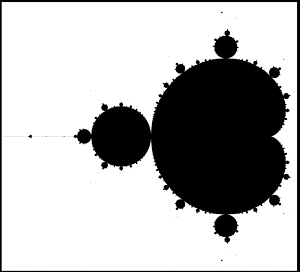
Likewise, when life swings too far past the "inner edge of chaos", the system loses its ability to self organize. This can be observed in cases of cancer where a subsystem of cells within the complete living system loses the ability to regulate expenditure of resources. In cancer, most cellular resources are allocated to reproduction instead of differentiation and functionality. The cancer cells replicate in exponential self-similar chaos fractal patterns like the common Mandelbrot geometic patterns of Merkel cell carcinomas.
Janecka suggests that many untreatable human diseases can be catagorized as pendulum swinging too far in either direction of the self-organizing/self-adapting systems. A swing in either direction plunges the living system into a stage of accelerating entropy ontil the system completely unravels at death. He goes on to suggest that scientists and clinicians could use the model to evaluate what needs to happen to a diseased patient to best bring them back to their healthy balance of order and chaos. In the case of cancer, Janecka proposes that efforts be made to re-educate the cancer cells to move back toward efficient energy consumption. Teach the cancer cells to differentiate again instead of reproduce. Re-balance the system.
The concept is fascinating and I look forward to following up on researcher who reference this publication.

----------------------------
The second publication I spent a lot of time attempting to wrap my feeble mind around this past weekend was a fascinating conceptual "modeling" paper written by Dr. Ivo Janecka, MD, MBA, PhD (that's a lot of letters...). As I mentioned in my post about Miuro, I am very much intrigued by chaos mathematics and non-linear dynamics. It is the most ambitious of my many amateur interests.
The introduction of Janecka's publication starts with a quote by Fritjof Capra saying:
"The more we study the major problems of our time, the more we come to realize that they cannot be understood in isolation. They are systemic problems, which means they are interconnected and interdependent."It is a sentiment which many scientists share, but is very easy to lose site of when we attempt to make our research efforts more manageable. We try to linearize our experiments. We pretend that we can study individual variables. We forget that we are usually attempting to solve complex problems rather than answer simple binary questions. In the twenty-first century, living systems and their "problems" are proving to be more complex than any systems humans have ever tried to understand.
When I decided to pursue a career in life sciences, it was because I could not imagine that any other field of study could offer systems as beautiful and mysterious as life. I also could not imagine a field that could offer so much promise to help fellow humans once some of the mysteries were unlocked.
In this publication, Janecka offers a conceptual model for life systems. He describes life as a "non-linear dynamical system following the principles of organized complexity" with a "health territory" defined by the the systems ability to self-organize and self-adapt.
OK, so what does that mean? Let's take it one part at a time.
What is a non-linear dynamical system?
This is a system where small changes to early conditions can directly result in hugely different results at some later time. Many people have heard of the concept of a butterfly fluttering its wings on the North American west coast resulting in dramatic changes to huge tropical weather system on the east coast. Weather patterns are good examples of non-linear dynamical systems.
What is self-organization?
A system that self-organizes is one that will find a way to go back to "normal" after it has been disrupted. Imagine a beehive that is completely buzzing with activity. Now, imagine throwing a very small pebble at that beehive and disrupting the activity of the bees. For a few moments, the bees buzz away and circle the hive, only to go right back to the hive. The hive then appears almost exactly as it had before it had been disrupted. The system always approaches an organized baseline of activity.
Life, specifically human life, is very much the same. Our bodies work to self-organize. When we suffer lacerations, bleeding stops and the lesion closes/heals. This propensity to self-organize is catagorized by Janecka into a "zone of order".
What is self-adaptation?
Self-adaptation can be described as a systems flexibility to change based on information received from outside to the system. If you have ever attempted to play the guitar, you will know that it hurts at first. Fingertips become raw. Forearms become very sore. Over time, the muscles in the hand and forearm become much stronger and the fingertips become calloused and less sensitive to pain. The system is self-adapting to the information conveyed from the environment. If we could not adapt the environment around us and we didn't have flexibility to express a variety of phenotypes, our species could not survive. This flexibility is catagorized by Janecka within the "inner edge of chaos".
If life is a self-organizing and self-adapting system, then, Janecka reasons, it can be described as a pendulum swinging back and forth through the "zone of order" and the "inner edge of chaos".
When life swings too far into the "zone of order", it is at the expense of adaptability. This can result in detrimental rigidity as in the case of ECG cardiac signalling. Lack of chaotic fluctuations in cardiac electical signalling invariably indicates cardiac disease because of its lack of adaptability to variable conditions of stress and strain. Imagine if your heart couldn't beat faster when you needed to run. You wouldn't be able to get oxygen to your blood and muscles fast enough. It would be detrimental to you as a "living system".
Likewise, when life swings too far past the "inner edge of chaos", the system loses its ability to self organize. This can be observed in cases of cancer where a subsystem of cells within the complete living system loses the ability to regulate expenditure of resources. In cancer, most cellular resources are allocated to reproduction instead of differentiation and functionality. The cancer cells replicate in exponential self-similar chaos fractal patterns like the common Mandelbrot geometic patterns of Merkel cell carcinomas.
Janecka suggests that many untreatable human diseases can be catagorized as pendulum swinging too far in either direction of the self-organizing/self-adapting systems. A swing in either direction plunges the living system into a stage of accelerating entropy ontil the system completely unravels at death. He goes on to suggest that scientists and clinicians could use the model to evaluate what needs to happen to a diseased patient to best bring them back to their healthy balance of order and chaos. In the case of cancer, Janecka proposes that efforts be made to re-educate the cancer cells to move back toward efficient energy consumption. Teach the cancer cells to differentiate again instead of reproduce. Re-balance the system.
The concept is fascinating and I look forward to following up on researcher who reference this publication.
Monday, June 25, 2007
State of the Art: GENE THERAPY- Pt2

See part 1
Viral Delivery
Most gene therapy strategies in research and clinical labs up until now have revolved around harnessing the evolved capabilities of viruses to deliver their viral genomes into cells. This is commonly known as use of a viral vector.
Let’s talk a little bit about viruses. Viruses are particles which can infect cells of living organisms. Viruses are made up of a protein shell encasing viral genetic material. In order to reproduce, viruses attach via their protein shells to cell surface membranes where they inject their genetic material. For normal disease causing viruses, the viral genetic material hijacks the cell’s protein and nucleotide generating machinery to produce more complete virus particles. The cycle continues until the immune system can seek and destroy the viral particles (unless the immune system is the target of the virus; as in the case of HIV). The process by which viruses deliver their viral genomes into cells is referred to as viral transduction.
In order to use a virus as a delivery vector, the viral genetic material basically needs to be removed and replaced with genetic material encoding the desired cellular product.
Retroviruses
There are a few different kinds of viruses which can be used for gene transduction. Retroviruses are one kind. Retroviruses store their genetic material in the form of RNA. When a retrovirus infects or transduces a cell, it introduces ins RNA and a few additional enzymes to the cell. The RNA is then copied to DNA inside the cell my an enzyme called reverse transcriptase. The new DNA is then inserted into the cell’s own genome by the integrase enzyme. The viral DNA is now a part of the host cell’s DNA. If the host cell divides, then any daughter cells will share the new DNA. The great thing about that from a gene therapy standpoint is the fact that there would be little or no need to introduce the therapeutic gene more than once. The downsides to it, however, are that:
1) The viral DNA can be incorporated into portions of the cell genome that result in faulty transcription of important genes. This could lead to cancer conditions caused by the gene therapy in the same way that human papillomavirus (HPV) predosiposes women for cervical cancer.
2) If the virus inserts itself into the wrong cell type, the genetic material could be passed on indefinitely within unintended cells for unintended results.
Adenoviruses
Adenoviruses are very different from retroviruses in that the genomic material which adenoviruses use to hijack a cell starts as DNA. Additionally, the DNA does not incorporate itself in the host cell’s genome. The viral DNA finds its way into the host cell’s nucleus where it is transcribed to RNA in the same way all nuclear DNA is transcribed. However, since the viral genes are not incorporated into the cell’s genome, the gene will not be duplicated and passed on to daughter cells after cell division. In one sense, this is advantageous from a gene therapists standpoint. It means that the gene product will only be produced as long as the transduced cells are alive. Long term side effects are minimal. The downside of this approach, however, is the fact that the virus would likely need to be administered more than once.
Adeno-Associated Viruses
The major downside to AAV is the fact that the viral particles are very small and cannot hold very much genetic material. They would be limited in what gene products they could code for.
So now you know the three types of viruses used for gene therapies. You also know their basic advantages and disadvantages. The next installment in this series will talk about non viral gene delivery techniques. After that, we will summarize the potentially therapeutic gene products being tested in contemporary research labs. We hope you are enjoying the content so far.
Subscribe to:
Posts (Atom)