
----------------------------
The second publication I spent a lot of time attempting to wrap my feeble mind around this past weekend was a fascinating conceptual "modeling" paper written by Dr. Ivo Janecka, MD, MBA, PhD (that's a lot of letters...). As I mentioned in my post about Miuro, I am very much intrigued by chaos mathematics and non-linear dynamics. It is the most ambitious of my many amateur interests.
The introduction of Janecka's publication starts with a quote by Fritjof Capra saying:
"The more we study the major problems of our time, the more we come to realize that they cannot be understood in isolation. They are systemic problems, which means they are interconnected and interdependent."It is a sentiment which many scientists share, but is very easy to lose site of when we attempt to make our research efforts more manageable. We try to linearize our experiments. We pretend that we can study individual variables. We forget that we are usually attempting to solve complex problems rather than answer simple binary questions. In the twenty-first century, living systems and their "problems" are proving to be more complex than any systems humans have ever tried to understand.
When I decided to pursue a career in life sciences, it was because I could not imagine that any other field of study could offer systems as beautiful and mysterious as life. I also could not imagine a field that could offer so much promise to help fellow humans once some of the mysteries were unlocked.
In this publication, Janecka offers a conceptual model for life systems. He describes life as a "non-linear dynamical system following the principles of organized complexity" with a "health territory" defined by the the systems ability to self-organize and self-adapt.
OK, so what does that mean? Let's take it one part at a time.
What is a non-linear dynamical system?
This is a system where small changes to early conditions can directly result in hugely different results at some later time. Many people have heard of the concept of a butterfly fluttering its wings on the North American west coast resulting in dramatic changes to huge tropical weather system on the east coast. Weather patterns are good examples of non-linear dynamical systems.
What is self-organization?
A system that self-organizes is one that will find a way to go back to "normal" after it has been disrupted. Imagine a beehive that is completely buzzing with activity. Now, imagine throwing a very small pebble at that beehive and disrupting the activity of the bees. For a few moments, the bees buzz away and circle the hive, only to go right back to the hive. The hive then appears almost exactly as it had before it had been disrupted. The system always approaches an organized baseline of activity.
Life, specifically human life, is very much the same. Our bodies work to self-organize. When we suffer lacerations, bleeding stops and the lesion closes/heals. This propensity to self-organize is catagorized by Janecka into a "zone of order".
What is self-adaptation?
Self-adaptation can be described as a systems flexibility to change based on information received from outside to the system. If you have ever attempted to play the guitar, you will know that it hurts at first. Fingertips become raw. Forearms become very sore. Over time, the muscles in the hand and forearm become much stronger and the fingertips become calloused and less sensitive to pain. The system is self-adapting to the information conveyed from the environment. If we could not adapt the environment around us and we didn't have flexibility to express a variety of phenotypes, our species could not survive. This flexibility is catagorized by Janecka within the "inner edge of chaos".
If life is a self-organizing and self-adapting system, then, Janecka reasons, it can be described as a pendulum swinging back and forth through the "zone of order" and the "inner edge of chaos".
When life swings too far into the "zone of order", it is at the expense of adaptability. This can result in detrimental rigidity as in the case of ECG cardiac signalling. Lack of chaotic fluctuations in cardiac electical signalling invariably indicates cardiac disease because of its lack of adaptability to variable conditions of stress and strain. Imagine if your heart couldn't beat faster when you needed to run. You wouldn't be able to get oxygen to your blood and muscles fast enough. It would be detrimental to you as a "living system".
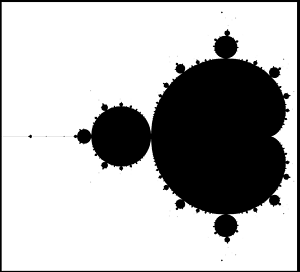
Likewise, when life swings too far past the "inner edge of chaos", the system loses its ability to self organize. This can be observed in cases of cancer where a subsystem of cells within the complete living system loses the ability to regulate expenditure of resources. In cancer, most cellular resources are allocated to reproduction instead of differentiation and functionality. The cancer cells replicate in exponential self-similar chaos fractal patterns like the common Mandelbrot geometic patterns of Merkel cell carcinomas.
Janecka suggests that many untreatable human diseases can be catagorized as pendulum swinging too far in either direction of the self-organizing/self-adapting systems. A swing in either direction plunges the living system into a stage of accelerating entropy ontil the system completely unravels at death. He goes on to suggest that scientists and clinicians could use the model to evaluate what needs to happen to a diseased patient to best bring them back to their healthy balance of order and chaos. In the case of cancer, Janecka proposes that efforts be made to re-educate the cancer cells to move back toward efficient energy consumption. Teach the cancer cells to differentiate again instead of reproduce. Re-balance the system.
The concept is fascinating and I look forward to following up on researcher who reference this publication.